
What Does the Bible Say About Overthinking?
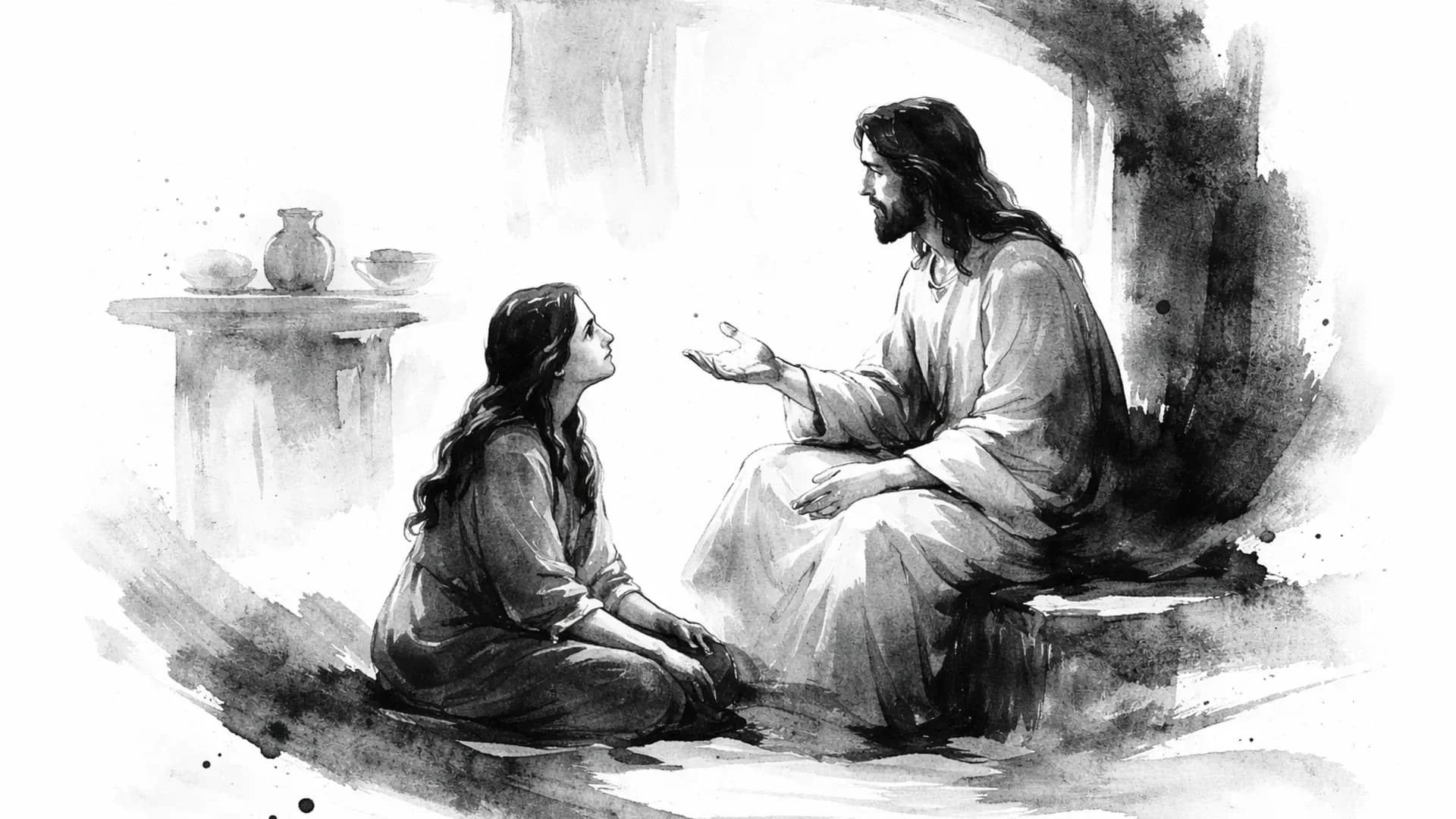
Your brain will not stop. You lie down at night and a crowd of thoughts shouts over each other. You replay conversations. You rehearse disasters. You solve problems that do not yet exist. And the harder you try to stop, the louder the noise gets.
The Bible has a word for this. Actually, it has two.
The Greek word (merimnao) μεριμνάω — "to be divided into parts" describes a mind pulled apart in ten directions. The Greek word (thorybazo) θορυβάζω describes a riot, a mob of noise inside the skull. Jesus used both words when He spoke to one woman in a kitchen. And His answer was not "try harder to think less." His answer was a Person.
This article traces what the Bible says about overthinking, examines the original Hebrew and Greek, and shows what it looks like to replace a divided mind with the sound mind God has already given you.
What Overthinking Looks Like in the Bible
The Bible does not use the word "overthinking." But it describes the condition with more precision than any psychology textbook.
Martha stood in a kitchen while Jesus sat in her living room. She had God incarnate under her roof, and she spent the visit worried about the menu. When she snapped at Jesus, "Lord, do You not care that my sister has left me to serve alone?" He gave one of the most diagnostic statements in the Gospels:
Two words. Worried. Troubled. In the Greek, these two words together paint a complete portrait of what happens inside the mind of an overthinker.
Jesus did not rebuke Martha for her work. He diagnosed what happened inside her. And His prescription was not a mental technique. It was a posture: sit. Mary sat at His feet. She received. That was the one thing.
The Greek Word Study: Merimnao and Thorybazo
Merimnao: The Divided Mind
The word translated "worried" in Luke 10:41 is (merimnao) μεριμνάω. It comes from (merizo) μερίζω, which means "to divide, to distribute into parts."
The literal picture is a mind split into fragments. You cannot hold one thought because ten others compete for attention. You sit at your desk but your mind is at the doctor's office, the bank, or last Tuesday's conversation all at once.
This is the same word Jesus used in the Sermon on the Mount:
The next sentence Jesus spoke was a question: "Is not life more than food and the body more than clothing?" He was not just calming nerves. He was pointing to quality of life. A fragmented mind does not just feel bad. It damages health and steals the abundant life Jesus promised. The word "life" here is (psyche) ψυχή — "soul" (your whole soul, your total well-being).
Thorybazo: The Riot of Thoughts
The word translated "troubled" is (thorybazo) θορυβάζω. It comes from (thorybos) θόρυβος, which means a riot, a tumult, a noisy crowd that disturbs public order.
Put these two words together: inside Martha's mind there was a crowd of thoughts pulled in every direction, and that crowd was loud. Not a low hum. A full riot. "You have not done this yet. Quick, do that. What about the bread? Why is no one helping? What if He thinks I am a bad host?"
That is overthinking. Not deep thought. Not careful analysis. A mob of thoughts that shouts and never resolves.
Jesus used a word from the same root, (throeo) θροέω, when He described the signs of the end times:
Same family of words. Same diagnosis. Whether the trigger is a kitchen or a global crisis, the pattern is identical: a mind divided into parts while a riot of thoughts demands your attention.
What a "Sound Mind" Actually Means in Greek
Paul wrote to Timothy from a Roman prison. Timothy was young and under pressure. Paul's prescription:
The phrase "sound mind" translates the Greek word (sophronismos) σωφρονισμός. This word deserves a closer look because it is the direct opposite of the merimnao-thorybazo condition.
Sophronismos comes from two roots: (sozo) σῴζω, which means "to save, to make whole," and (phren) φρήν, which means "the mind, the seat of thought." A saved mind. A whole mind. A mind that has been rescued and restored to proper function.
This is not self-discipline or willpower. The word does not describe a mind that has trained itself to stop racing. It describes a mind that has been acted upon: saved, made whole, restored. God did the work. You received the result.
Paul drew a contrast. He did not say "God has not given us overthinking, but He gave us the ability to stop overthinking." He said God gave three gifts: (dunamis) δύναμις — "power", (agape) ἀγάπη — "love", and (sophronismos) σωφρονισμός — "sound mind". These are deposits, not achievements. They already belong to you in Christ.
The overthinker's real problem is not that they think too much. It is that they do not know what they already have. You are not your thoughts. You have the mind of Christ.
12 Bible Verses About Overthinking
1. Philippians 4:8: The Replacement Strategy
Paul did not say "stop thinking bad thoughts." He said replace them. He gave a filter with six categories. True. Noble. Just. Pure. Lovely. Of good report. This is not positive thinking. It is directed attention toward what God says is real.
2. Isaiah 26:3: The Kept Mind
The Hebrew for "perfect peace" is (shalom shalom) שָׁלוֹם שָׁלוֹם — "perfect peace". Peace doubled, peace multiplied. And the word "stayed" means fixed, supported, leaned upon. A mind leaned on God does not race because it has found its weight-bearing wall. The overthinking mind has no anchor. This mind has one.
3. 2 Corinthians 10:5: Taking Thoughts Captive
The word "arguments" is (logismos) λογισμός — "reasonings". These are the mental constructs the mind builds to fortify a position. This is where overthinking becomes a stronghold. The mind builds an elaborate case for worry. Paul said tear it down. But you bring it captive to the obedience of Christ, not your own obedience. The standard is His finished work, not your performance.
4. 2 Timothy 1:7: The Sound Mind Gift
The word "fear" here is not the common (phobos) φόβος. It is (deilia) δειλία — "cowardice". The sound mind (sophronismos) is not the absence of thoughts. It is a mind that has been made whole.
5. Romans 12:2: The Renewed Mind
The word "renewing" is (anakainosis) ἀνακαίνωσις — "renovation". The word "mind" is (nous) νοῦς — "mind" (the faculty of perception, understanding, and judgment). God does not patch the old mind. He renovates it. Renewal starts where agreement with God's Word starts.
6. Psalm 94:19: Comfort Inside the Chaos
The psalmist did not pretend the anxious thoughts had left. They multiplied. And right in the middle of them, not after they resolved, God's comforts arrived. You do not need to sort out every thought before God meets you. He meets you in the multitude.
7. Proverbs 3:5-6: Do Not Lean on Your Own Understanding
Overthinking is the mind's attempt to figure everything out before it moves. Solomon said the opposite: trust first, and the direction will come. The word "lean" is (sha'an) שָׁעַן — "to lean upon". Stop leaning on your own analysis. Lean on Him.
8. Matthew 6:27: The Futility Question
Jesus asked a question that every overthinker should tape to their mirror. Has overthinking ever added a single day to your life? A single centimeter to your height? A single dollar to your account? Worry promises results and delivers nothing but exhaustion and lost peace.
9. Psalm 139:23-24: God Knows Your Thoughts
David did not try to sort his own thoughts. He invited God to do it. There is a difference between introspection and invitation. Introspection leads to more overthinking. Invitation leads to God's verdict, and His verdict is always grace.
10. 1 Peter 5:7: Cast the Whole Weight
The Greek word for "casting" is (epirrhipto) ἐπιρρίπτω — "to cast upon". It is aorist tense: a once-for-all, decisive transfer. The reason? Not your strength. His affection: "for He cares for you", which is present tense, perpetual, and never interrupted.
11. John 14:27: His Peace, Not the World's
Jesus said "My peace." The same peace He operated in when He slept through a storm at sea. He did not teach a technique. He transferred a possession. The world's peace depends on good circumstances. His peace operates inside the difficulty.
12. Philippians 4:6-7: Peace That Guards
The word "guard" is (phroureo) φρουρέω — "to guard" (a military term for a garrison that stands watch). When you hand your overthinking to God, His peace deploys like a soldier at the gate of your mind. The peace does the guarding. You do not generate it. You receive it.
The Connection Between Overthinking and Rest
When Israel arrived at a place called Rephidim, a Hebrew word that means "resting places", Amalek attacked (Exodus 17:8). The name Amalek comes from the root (amal) עָמָל, which means painful toil and wearisome labor.
The pattern is consistent across Scripture. Every time you approach rest, the spirit of anxious toil resists. Your only battle under grace is to remain at rest.
Moses stood on the hill with arms raised. When his hands dropped, Amalek prevailed. When Aaron and Hur helped him by making him first sit down, Israel prevailed. Nobody sits in a battle. Yet that is God's strategy. Sit first. Victory follows.
The Hebrew word (chuwsh) חוּשׁ — "haste" is an onomatopoeia that sounds like a sudden gust of wind. Isaiah 28:16 says:
Peter quoted this same verse in 1 Peter 2:6 and translated it as "will by no means be put to shame." The Holy Spirit connected the two ideas: the person who believes does not rush, and the person who does not rush will not be put to shame. Overthinking is hurry turned inward. It is the mind in haste.
Hebrews 4:11 frames it as the believer's one assignment:
The only diligence God asks for is the diligence to stop striving.
Your Mind Needs a Helmet (And That Helmet Is Hope)
Paul listed the armor of God in Ephesians 6. Each piece corresponds to a gospel truth, not a human effort. The piece that protects the mind is:
In 1 Thessalonians 5:8, Paul called it "the hope of salvation", the confident expectation that your salvation is secure and complete. The Greek word for hope, (elpis) ἐλπίς — "hope", means a favorable and confident expectation of good. Not wishful thinking. A settled assurance about the future.
For the overthinker, this means that when you lose the hope of salvation, when you start to wonder if God is still for you, if your future is still good, or if the finished work covers you, the helmet comes off and your mind becomes an open field.
Every piece of the armor is doctrinal, not behavioral. The breastplate is righteousness received, not achieved. The shield is faith in Christ's finished work, not faith in your own effort. And the helmet is the confident hope that your salvation is sealed. When that hope is intact, the mind is protected. When that hope cracks, the overthinking floods in.
This explains why some believers experience a sudden onset of oppressive thoughts. Something shook their assurance. A wrong teaching. A condemning voice. A belief that God's acceptance is conditional. The remedy is not willpower. It is right believing. Put the helmet back on.
How to Replace Rumination with the Word
There is a detail in Hebrew that most people miss. The Hebrew word for "bread" is (lechem) לֶחֶם. The Hebrew word for "fight" or "battle" is (lacham) לָחַם. Same root letters. Same origin.
In other words, the way you fight is by feeding. When Israel fought Amalek at Rephidim, the word used for "fought" is (lacham) לָחַם, the same word that gives us "bread." The connection is deliberate. You do not defeat overthinking by white-knuckling your way to silence. You defeat it by feeding on the Word of God.
Psalm 1 describes the blessed person:
The Hebrew word (hagah) הָגָה — "to meditate" means to murmur or speak under your breath. Biblical meditation is not emptying the mind. It is filling the mouth. You read a verse. You say it aloud. You turn it over. You say it again. The sound of God's Word replaces the riot of anxious thoughts.
David said it plainly:
The word "mused" shares a root with "meditate." As David chewed on God's Word, something ignited inside him. The noise of overthinking cannot survive in a mind that is occupied with the Word. You cannot be occupied with the Word and the enemy at the same time.
This is not a self-help technique. It is a displacement strategy. You do not push dark thoughts out. You crowd them out with something better. Philippians 4:8 gave you the filter. Psalm 1:2 gave you the method. Speak it. Mutter it. Roll it over in your mouth until it burns.
The Gospel's Answer to an Overactive Mind
The gospel's answer to overthinking is not "think less." It is "receive more."
Power has already been given. Love has already been given. A sound mind, (sophronismos) σωφρονισμός, a saved and whole mind, has already been given. Peace that surpasses understanding has already been stationed at the gate of your mind.
The overthinker believes they must figure everything out before they can rest. The gospel says rest first, and clarity will follow. Start where Jesus finished.
You are not climbing toward a sound mind. A sound mind has already come down to you.
Enjoyed this? Get a short devotional like this in your inbox every morning.