
What Does Amen Mean? The Word That Agrees With God
Most Christians say amen several times a week. We say it at the end of a prayer, after a worship song, and when a preacher says something we know is true. Amen means "it is true" or "so be it." It comes from a Hebrew root that means firm, faithful, and dependable, so saying amen means you agree that what was just said can hold your weight.
Few of us stop to ask where the word came from. It is one of the oldest words in the Bible, and most languages never translated it. English, Japanese, Korean and Indonesian Christians all say a form of the same Hebrew word that Israel said at Mount Ebal more than three thousand years ago.
The word has more inside it than a polite ending. Jesus used it in a way no rabbi before Him did. Paul tied it to every promise God ever made. And the last book of the Bible uses it as a name for Jesus.
This article traces amen from its Hebrew root, through the Old Testament and the words of Jesus, to the reason we still say it at the end of our prayers.
Amen Meaning in Hebrew
The Hebrew word is (amen) אָמֵן — "surely, truly, so be it." Strong's Concordance numbers it H543. It is pronounced ah-MANE.
Strong's gives the word three senses:
- Sure: something that is firm and will not give way.
- Faithfulness: the quality of a person or a word that can be trusted.
- An adverb meaning "truly" that confirms what was just said.
Amen appears 30 times in the Hebrew Old Testament. Most English Bibles leave it untranslated as "Amen." In one verse, Isaiah 65:16, translators render it "truth" twice.
In almost every case, amen is a response. Someone else speaks first. Then a person, or a whole crowd, answers "Amen." Amen always comes second. It confirms what someone else has said.
That is the plain meaning of amen in Hebrew: what you just said is firm, and I stand on it.
The Root: Aman, Faith, and Truth
Amen comes from the verb (aman) אָמַן — "to support, to be firm, to be faithful," Strong's H539. The verb appears 108 times. Its most basic sense is to hold something up or to support it. The same verb describes a parent or a nurse who carries a child (Numbers 11:12 uses it for a nursing father).
From that idea of holding up, the word grows into firmness, then into faithfulness, then into trust. Something you can lean on is something you can believe.
Several important Bible words come from this one root.
Emunah: Faith That Holds Steady
The noun (emunah) אֱמוּנָה — "firmness, faithfulness, faith," Strong's H530, comes from the same family. Its first use in the Bible is a physical picture.
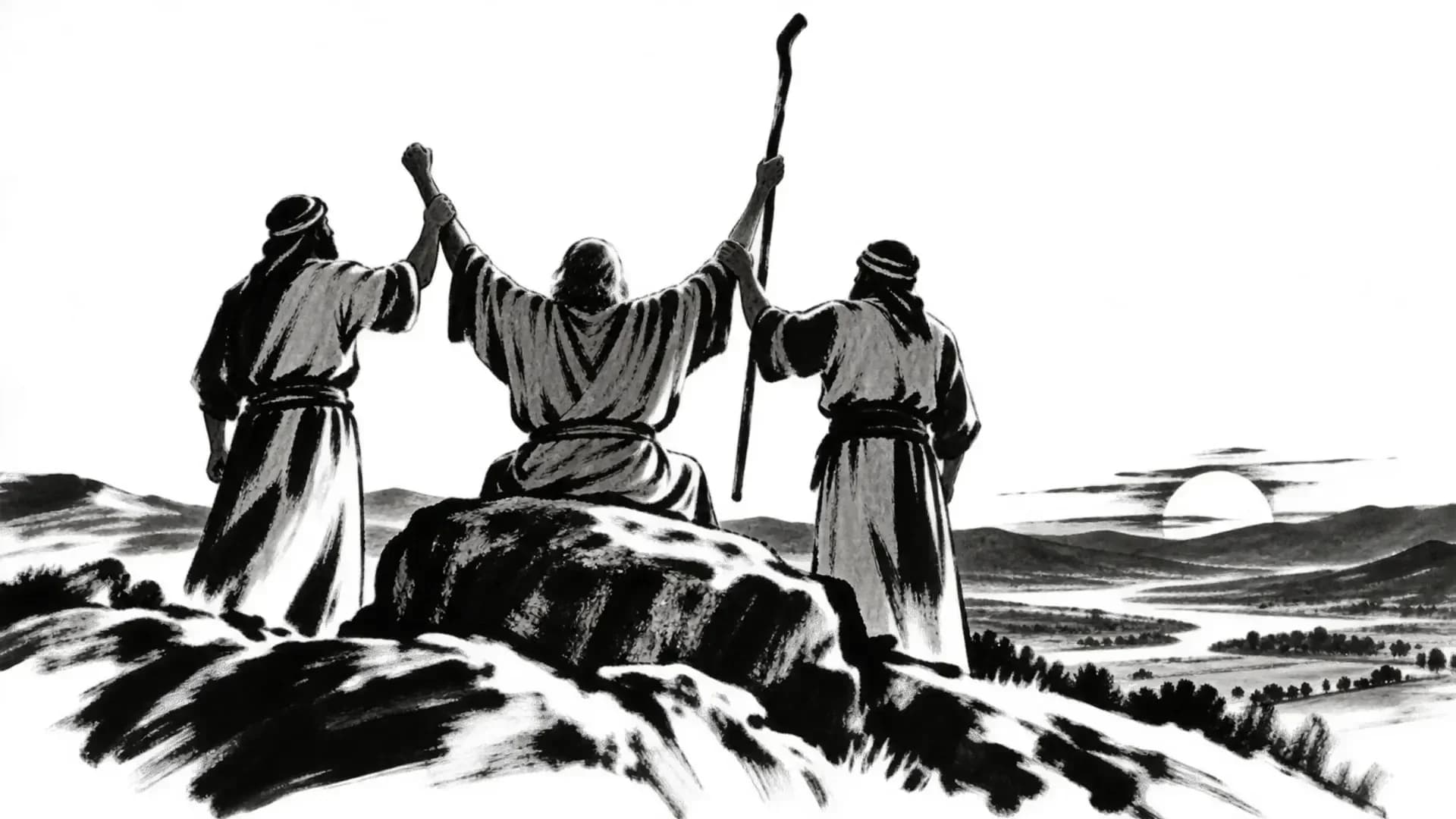
When Israel fought Amalek, Israel won while Moses held up his hands, and Israel lost when his hands came down. Moses got tired. So Aaron and Hur sat him on a stone and held up his arms.
The word "steady" is emunah. Before emunah meant faith, it meant arms that did not drop because someone was holding them up. That is a good picture of biblical faith. It is less about how strong you feel and more about what is holding you.
Emet: Truth You Can Lean On
The word (emet) אֶמֶת — "truth, stability, faithfulness," Strong's H571, is a shortened form from the same root. It is the word that pairs with hesed when God describes Himself as "abounding in goodness and truth" (Exodus 34:6). I traced that pairing in the article on what hesed means. In Hebrew thinking, truth is something stable enough to build on.
Abraham Believed: The Verb Behind Faith
The first time the Bible says a person believed God, it uses this root.
The word "believed" is (he'emin) הֶאֱמִן — "he believed, he trusted," a causative form of aman. A literal sense is that Abraham leaned his weight on God, or counted God as firm. Abraham had no son yet. He and Sarah were too old to have one. God made a promise, and Abraham responded with the same root that gives us amen.
Paul explains what that looked like.
Abraham looked at his own body and then looked at the promise, and he chose the promise. I wrote more on that choice in Consider Not the Body, Consider the Promise.
Believe and Be Established
One verse puts two forms of the root side by side. Before a battle, King Jehoshaphat told Judah:
"Believe" is (ha'aminu) הַאֲמִינוּ — "believe, trust." "You shall be established" is (te'amenu) תֵאָמֵנוּ — "you will be made firm." Both come from aman. In plain English, the verse says: lean on God, who is firm, and you will be made firm. Isaiah 7:9 uses the same pair of words.
So when you say amen, you are using a word from the same family as faith, faithfulness, and truth. They are all one idea in Hebrew: something firm enough to hold you up.
Amen in the Old Testament
The Old Testament uses amen in a few clear settings. Each one adds to the meaning.
The First Amen: Accepting a Word Spoken Over You
The first amen in the Bible is in Numbers 5. A woman accused of unfaithfulness heard the priest pronounce an oath over her. Then she answered.
The NKJV adds "so be it" to show what the double "amen, amen" means. Her amen accepted the words spoken over her as binding.
Twelve Amens at Mount Ebal
The longest run of amens is in Deuteronomy 27. When Israel entered the land, the Levites read out twelve curses from Mount Ebal. After each one, the whole nation answered.
Under the law, Israel said amen to curses. They agreed that anyone who broke the law deserved what the law said.
Paul quotes this verse in Galatians, and then he gives the answer.
Israel's amen at Mount Ebal agreed with a curse. Jesus took that curse on Himself. Under the new covenant, the believer's amen is said to blessings instead.
An Amen That Asks God to Confirm It
When King David named Solomon as the next king, his officer Benaiah answered:
Benaiah's amen meant two things. He agreed with the king. And he asked God to back the king's word. A human amen is only as strong as the God who stands behind the word.
Amen in Worship
When David brought the ark to Jerusalem, the song ended with a blessing on God, and the crowd answered.
After the exile, when Ezra opened the book of the law in front of the people, the same thing happened.
The book of Psalms is divided into five books, and four of them end with amen (Psalm 41:13, 72:19, 89:52, and 106:48). The last of those closings tells everyone to join in.
Amen was never the leader's word alone. It belonged to the people. The leader blessed God, and the people agreed out loud.
The God of Amen
One verse in Isaiah uses amen as a description of God Himself.
In Hebrew, "the God of truth" is (Elohei amen) אֱלֹהֵי אָמֵן — "the God of amen." He is the God whose word is firm. Keep that phrase in mind. The New Testament picks it up again.
Amen in Greek and the New Testament
When the New Testament writers wrote in Greek, they did not translate amen. They kept the Hebrew sound and wrote it in Greek letters: (amen) ἀμήν — "truly, so be it," Strong's G281.
The word appears well over a hundred times in the Greek New Testament. The exact count depends on the Greek manuscript tradition, so lexicons give different totals. The NASB, for example, renders it "truly" 99 times and "Amen" 30 times.
The older Greek translation of the Old Testament, the Septuagint, usually translated the Hebrew amen with (genoito) γένοιτο — "may it be, let it happen." That is the same word Mary used when the angel told her she would carry the Messiah.
Mary did not say the word amen. But "let it be" (genoito) is the Greek word that so often stood in for it. Her answer is what an amen sounds like in a life. She did not understand how God would do it. She agreed that He would.
"Assuredly, I Say to You": How Jesus Used Amen
Jesus used amen in a way that had no clear parallel in Jewish practice before Him. Everyone else said amen at the end, in response to someone else's words. Jesus said it at the start, before His own words.
The King James Version translates this as "Verily, I say unto you." The NKJV translates it as "Assuredly, I say to you."
The thief on the cross had nothing to offer and no time to improve. Jesus put an amen in front of His promise to him. The man could die with that word under him.
"Most Assuredly": The Double Amen in John
In John's Gospel, Jesus doubles the word: "Amen, amen, I say to you." John records this 25 times, and no other Gospel uses the double form. The NKJV translates it "Most assuredly."
When a believer says amen, he confirms a word God has spoken. When Jesus said amen first, He confirmed His own word before He said it. He did not need a second witness. He spoke as the One whose word is already firm.
The writer of Hebrews describes God doing something similar for our sake.
God did not need to swear. He swore so that we would have more to stand on. Jesus' "Assuredly" does the same work. It is extra assurance, given to people who struggle to believe.
Yes and Amen: 2 Corinthians 1:20
The best-known amen verse in the Bible came out of a change in travel plans.
Paul told the Corinthians he would visit them. Then he changed his plans. Some people in the church said this proved Paul was unreliable. If he could not keep his word about a trip, how could they trust his gospel?
Paul answered that his message was not "Yes" one day and "No" the next, because the God behind it is faithful.
Then he wrote the verse many believers know by heart.
The verse has two parts, and the order matters.
First, God's side: all the promises of God in Him are Yes. The promises are not Yes because you have earned them. They are Yes "in Him," in Christ. Jesus fulfilled every condition, so every promise is settled for those who are in Him. A promise says something about the person who made it. It depends on the faithfulness of the Promiser, not on the performance of the one who receives it.
Second, our side: in Him Amen, to the glory of God through us. The amen comes "through us." God says Yes. We say Amen. The Yes is His work, finished in Christ. The amen is our agreement with it.
This is grace. Your amen does not turn God's No into a Yes. God already said Yes. Your amen is you saying, "I believe You meant it." And Paul says that agreement brings glory to God, because it shows that He can be trusted.
Jesus Is the Amen
In Revelation, Jesus dictates letters to seven churches. To the last church, in Laodicea, He introduces Himself this way:
"The Amen" is a name. Isaiah spoke of "the God of amen." Here Jesus takes the title for Himself. Then He explains it: "the Faithful and True Witness." Faithful and true are the same two ideas that the root aman carries.
The setting adds weight. Laodicea was the church Jesus called lukewarm, neither hot nor cold (Revelation 3:15-16). They were the least steady church on the list. And to them, Jesus introduced Himself as the steady One.
That is good news for anyone whose faith goes up and down. Your amen will not always be loud. Some weeks you will barely believe what you are saying. But your security does not rest on the strength of your amen. It rests on Jesus, who is the Amen.
Moses' hands stayed steady because Aaron and Hur held them up. Your faith stays steady because Christ holds it. You say amen because He is the Amen.
Why Do We Say Amen at the End of a Prayer?
Christians end prayers with amen because the Bible shows God's people doing it, and because of what the word means.
Jesus taught His disciples a pattern for prayer, and in the NKJV it ends with amen.
Paul assumed that when someone in church prayed or gave thanks, the others would answer "Amen." He also said they could only do that if they understood what was said.
That verse tells us something useful. An amen is meant to be informed agreement. You say it because you heard the words and you agree with them.
The Bible itself ends this way.
Jesus makes a promise: "Surely I am coming quickly." John answers with amen, and then turns the promise into a prayer: "Even so, come." That is the pattern of every good amen. God speaks first. We agree, and we ask Him to do what He said.
So when you end a prayer with amen, you are saying two things in one word. You agree with what God has said about the thing you prayed for. And you are trusting Him to carry it, instead of trusting the quality of your words.
When you say amen to someone else's prayer, you join it. It becomes your prayer too, the way the whole crowd joined Ezra's blessing.
What Amen Is Not
Because we say it so often, amen can lose its meaning. A few common misunderstandings are worth naming.
It Is Not a Sign-Off
Many people use amen the way a radio operator says "over and out." It marks the end and nothing more. But amen is a statement. It means "this is firm." You can say it in the middle of a sentence, at the start of one (as Jesus did), or under your breath while reading a promise. Its job is agreement, and the end of a prayer is only one place to agree.
It Is Not a Magic Seal
Some believers worry that a prayer without amen at the end will not count, as if amen were a password. The Bible never teaches that. Your prayer is heard because of Jesus, not because of the last word you used.
Jeremiah gives a clear example. A false prophet named Hananiah announced that the exiles would come home from Babylon within two years. Jeremiah wanted that to be true.
Then Jeremiah warned that only time would prove whether Hananiah's word came from God. It did not. Jeremiah's amen expressed a wish, but it could not make a false word true. Amen has no power of its own. Its power comes from the word it agrees with.
It Is Not How You Earn the Promise
It is possible to hear "say amen to receive the promise" and turn it into a new kind of work. Did I say it enough? Did I say it with enough faith?
Go back to 2 Corinthians 1:20. The promises are already Yes in Christ. Your amen receives what is already given. Abraham did not earn the promise by believing. He received what God had freely promised, and God counted his trust as righteousness. Faith is the hand that takes the gift, and taking a gift pays nothing.
What Changes When You Say Amen
If amen is agreement, then saying it on purpose changes how you read the Bible and how you pray. This matters most on the days when your circumstances say one thing and Scripture says another.
Read a Promise, Then Agree With It
When you read a promise in Scripture, stop and say amen to it. Do it out loud if you can. Take a verse like John 5:24, "he who hears My word and believes in Him who sent Me has everlasting life." Jesus put a double amen in front of it. Put yours after it. Agreement spoken out loud is how faith works in the Bible, from Abraham to Mary. I wrote more on that in Saying What God Says Is How Faith Works.
Let the Promise Outweigh the Report
You may be sitting in a hospital waiting room, or looking at a bank balance that does not cover the month. You can see the problem clearly. God's promise gives you something firmer to lean on than what you see. Abraham "did not waver at the promise of God through unbelief." He did not deny his age. He decided the promise was firmer than his body.
Let Others Hold Your Arms
Moses could not keep his hands up alone. Aaron and Hur held them, and his hands were "steady," emunah, until sunset. That is one reason God's people say amen together. When you are too tired to believe on your own, sit in a church and hear the people around you agree with God's promises. Their amen can help hold up your arms.
Keep Your Amen Honest
Paul wanted amens that came from understanding. You do not need to shout amen to everything said from a stage. Test what you hear against Scripture. Then, when it lines up with what God has said, agree with it fully. An informed amen is worth more than a loud one.
God Says Yes. You Say Amen.
Amen is a small word with a long history. It comes from a Hebrew root that means to hold up and to be firm. It shares that root with the Bible's words for faith and truth. Israel said it to curses at Mount Ebal, and Jesus took those curses on the cross. Jesus put it at the front of His promises so we would know they were firm. Paul tied it to every promise God has made. And Revelation gives it to Jesus as His name.
Every time you say amen, you agree with a God who has already said Yes. You are not adding strength to His promise. You are putting your weight on it.
Amen does not make God's promise true. It means you have decided to lean your whole weight on it.
Enjoyed this? Get a short devotional like this in your inbox every morning.