
What Does Hallelujah Mean? The Praise That Follows the Rescue
A man stands at the back of a funeral and hears the choir sing "Hallelujah." Two weeks later he hears the same word at a Christmas concert, then again on the radio in a love song. Hallelujah means "Praise the LORD." It is a Hebrew phrase, halelu-Yah, that calls a group of people to praise Yah, the short form of God's personal name.
That is the dictionary answer. The Bible gives a fuller one.
The word appears about two dozen times in the Hebrew Psalms and four times in the Greek New Testament, all in one chapter of Revelation. It opens and closes the last five psalms in the Bible. It was sung at the Passover table. And in Revelation 19, a crowd in heaven says it four times in a row.
In almost every one of those places, the word comes with a reason attached. The psalm tells you why to praise before or after it tells you to praise. That pattern is the key to the whole word. Hallelujah is what people say after God has acted. It is a response to a rescue, and it was never the price of one.
This article walks through the Hebrew behind hallelujah, where it appears in the Bible, and what it changes in an ordinary week.
Hallelujah Meaning in Hebrew
In Hebrew, hallelujah is written (halelu-Yah) הַלְלוּ־יָהּ — "praise Yah, praise the LORD." Some Hebrew texts write it as one word, הַלְלוּיָהּ, and others join the two parts with a short hyphen called a maqaf. Either way, it is two words pressed together.
The first part is (halelu) הַלְלוּ — "praise, all of you." It is a command, and it is plural. The psalmist is not talking to himself. He is speaking to a room full of people, or to a whole nation, or in Psalm 150 to "everything that has breath."
The second part is (Yah) יָהּ — "LORD," the shortened form of God's covenant name.
So the plainest English rendering is "Praise the LORD!" or, to keep the plural, "All of you, praise the LORD!" Strong's Concordance does not give the Hebrew phrase its own number. It treats it as a combination of two entries: H1984 (halal) and H3050 (Yah). The Greek form in Revelation does have its own number, G239.
The Root Word: Halal
The verb behind hallelujah is (halal) הָלַל — "to praise, to boast, to shine." It is Strong's H1984, and it occurs about 165 times in the Old Testament.
Hebrew lexicons give halal a wide range. In some forms it means "to shine" or "to give light." In its most common form it means "to praise." In another form it means "to boast" or "to glory in." And in one unusual form it means "to act like a madman."
That last meaning shows up in a well-known scene. When David fled from Saul to the Philistine city of Gath, he was afraid the king there would recognize him. So he acted insane.
The words "pretended madness" come from halal. (Hebrew Bibles number this verse 21:14.) David later wrote Psalm 34 about that same escape, and in the second verse he uses halal again, this time in the sense of boasting:
The man who had acted like a fool to save his own life now boasts in the God who actually saved it. The same root covers both.
This "boasting" sense helps explain hallelujah. To praise someone in Hebrew is to brag about them. You talk about what they did, out loud, where other people can hear. God uses the same verb in Jeremiah:
Every "glory" in that passage is halal. God tells people to stop boasting about what they have done and start boasting about what He does. The first thing on His list is "lovingkindness," which is the Hebrew word hesed, God's covenant love. The boast He wants from us is a boast about His kindness.
That is hallelujah in one sentence: brag about God, together, out loud.
Yah: The Short Form of God's Name
The second half of hallelujah is (Yah) יָהּ — "LORD." It is Strong's H3050, a short, poetic form of God's personal name, the four-letter name that most English Bibles print as "LORD" in capital letters. Yah appears about 48 times in the Old Testament, mostly in songs and psalms.
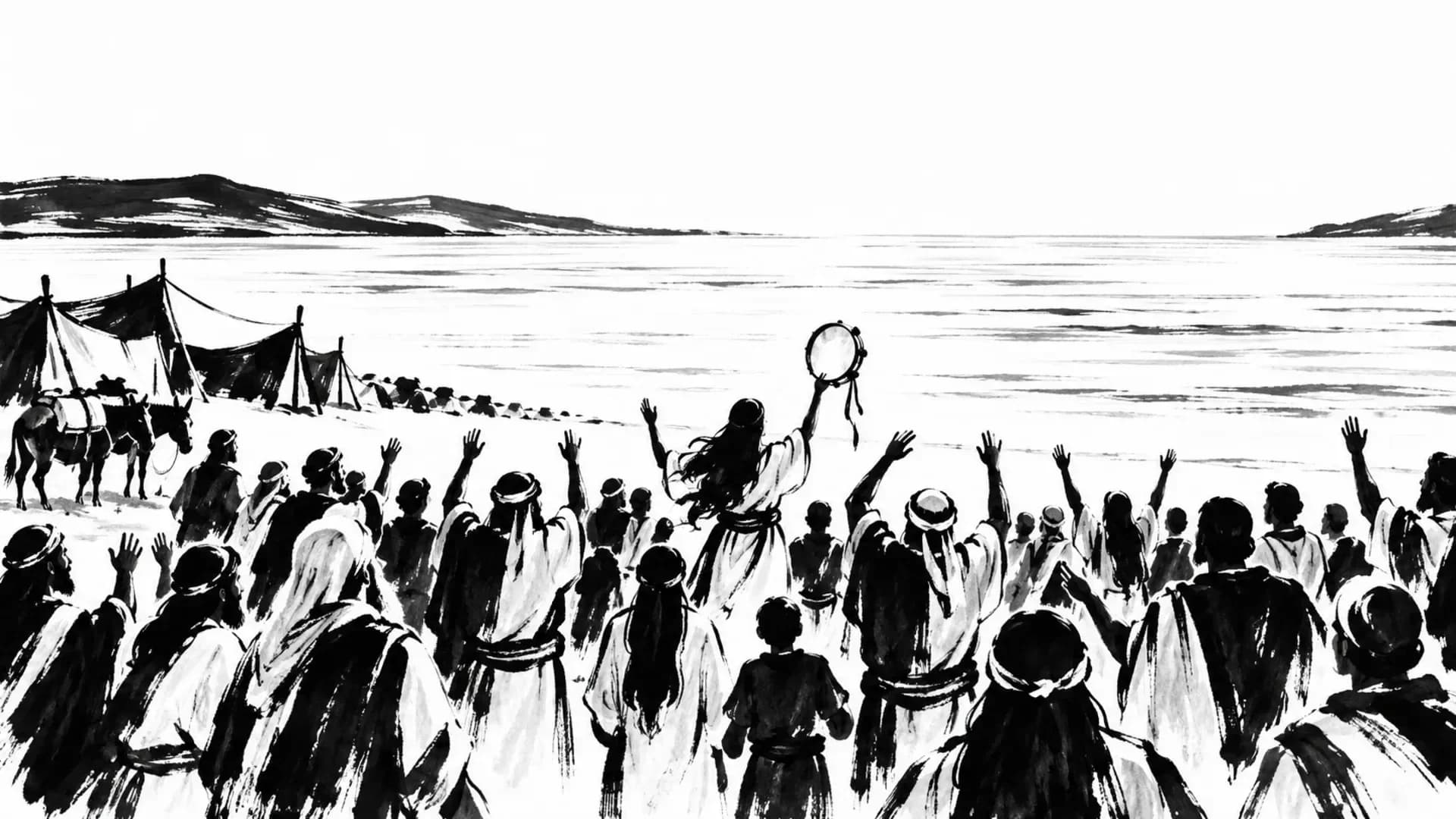
Its first appearance in a song is on the shore of the Red Sea, right after Israel walked through on dry ground and watched Pharaoh's army drown:
The first "LORD" in that verse is Yah. It is worth stating what came first. Israel did not sing their way across the sea. God opened the sea, they crossed, and then they sang. The name Yah enters Israel's worship as the name of the God who had just rescued them.
Hallelujah in the Bible: Where It Appears
In the Psalms
By the standard count, the Hebrew phrase halelu-Yah appears 24 times in the Old Testament, and every one of them is in the book of Psalms. Counts vary slightly between scholars, because a few verses use a similar phrase with God's full name instead of Yah.
The first occurrence is the last line of Psalm 104:
From there it clusters in the last third of the book. It opens or closes Psalms 105, 106, 111, 112, 113, 115, 116, 117, 135 and others. The final five psalms, 146 through 150, each begin and end with it. The book of Psalms finishes with a hallelujah:
Psalm 150 is only six verses long, and the verb halal appears in it thirteen times. The Psalms end on praise, said over and over.
The Hebrew name for the whole book points the same way. Jews call the Psalms (Tehillim) תְּהִלִּים — "praises," a plural of (tehillah) תְּהִלָּה, a noun built from halal. The book of Israel's prayers, laments and complaints is named after its praise.
Why your NKJV says "Praise the LORD!"
If you search an NKJV Bible for the word "hallelujah," you will not find it in the Psalms. The NKJV, like the King James Version before it, translates the phrase into English as "Praise the LORD!" So every time you read "Praise the LORD!" as a stand-alone exclamation at the start or end of a late psalm, the Hebrew underneath is very often hallelujah.
In the New Testament
The New Testament uses the word only four times, all in Revelation 19 (verses 1, 3, 4 and 6). The Greek spelling is (allelouia) ἀλληλουϊά — "praise the LORD," Strong's G239. It is not a Greek word at all. It is the Hebrew phrase spelled out in Greek letters, the same way English speakers say "hallelujah" without translating it.
Hallelujah or Alleluia? Why the Spelling Changes
People often ask whether "hallelujah" and "alleluia" are two different words. They are the same word.
Hebrew begins the word with a breathed "h" sound. Greek handled that sound with a small mark over the first letter rather than a full letter, and Latin dropped it. So the Greek allelouia became the Latin "alleluia," and that spelling entered church use through the Latin Bible and Latin hymns.
The NKJV keeps the Greek-based form in Revelation, which is why you read "Alleluia!" there. English songs and many other Bibles use the Hebrew-based "hallelujah." Both mean "Praise the LORD."
The Hallel Psalms and the Passover Table
Psalms 113 to 118 form a group that Jewish tradition calls the Hallel, from the same root halal. It is sometimes called the Egyptian Hallel, because Psalm 114 retells the exodus from Egypt.
The Hallel was sung at the Passover meal. According to the Mishnah, the early Jewish law code, the custom was to sing Psalms 113 and 114 before the meal and Psalms 115 to 118 after it.
The order matters. Passover remembered a night when a lamb died, its blood was put on the doorposts, and judgment passed over the house. Israel did nothing to earn that night. They stayed inside, ate the lamb, and walked out free the next morning. The Hallel was the song of people who had been carried out.
Psalm 113 opens with "Praise the LORD!" and then gives the reason:
The poor man in that psalm does not climb out of the ash heap. God lifts him and seats him with princes. That is the reason for the hallelujah.
The Hallel ends with Psalm 118, which opens like this:
And later in the same psalm:
Jesus applied that rejected stone to Himself in Matthew 21:42. On the night of the Last Supper, which was a Passover meal, Matthew records:
Matthew does not name the hymn. Many commentators believe it was the second half of the Hallel, since that was the song that closed a Passover meal. If so, Jesus sang "The stone which the builders rejected" hours before the builders rejected Him. He sang "This was the LORD's doing" on His way to the place where the LORD would do it. That identification is a strong tradition, not a stated fact, but it fits the Passover setting.
Either way, the pattern of the Hallel is clear. The lamb comes first. The hallelujah comes after.
Hallelujah in Revelation 19
The last hallelujahs in the Bible come at the end of history. Revelation 19 records a great multitude in heaven:
The chapter repeats the word three more times. The second "Alleluia!" follows God's judgment on the city that persecuted His people (verse 3). The third comes from the twenty-four elders and the four living creatures, who fall down and say "Amen! Alleluia!" (verse 4). The fourth is the loudest:
Each Alleluia in Revelation 19 comes with a reason. Salvation belongs to God, and nobody in that crowd claims a share of it. The bride in verse 7 is ready, and the next verse tells you where her wedding clothes came from:
She was given the linen. Heaven's hallelujah is a crowd of rescued people telling the truth about who did the rescuing.
The same Lamb from the Passover table stands at the center of Revelation's worship. The Bible's hallelujahs start with a lamb in Egypt and end with the Lamb on the throne.
Hallelujah and the Other Hebrew Words for Praise
Hebrew has several words that English Bibles translate as "praise," "thanks" or "bless." Knowing the differences helps you read the Psalms more accurately. Here are the main ones.
Halal: praise as public boasting
(Halal) הָלַל — "to praise, to boast," H1984. As covered above, this is praise spoken about God, often to other people. It is loud and public. Hallelujah is its most famous form.
Yadah: praise with the hands
(Yadah) יָדָה — "to throw, to give thanks, to praise," Strong's H3034, about 114 occurrences. The root idea is extending the hand. In its most common form it means to give thanks or to acknowledge.
Its first use as praise is in the story of Leah. She was the wife Jacob did not want. With each of her first three sons she said a version of the same thing: now my husband will love me. With the fourth son, she said something different:
The verb is yadah, and the name Judah comes from it. Leah stopped measuring her life by her husband's response and started thanking God for what she already had. From Judah's line came David, and from David's line came Jesus.
Todah: the thank offering
(Todah) תּוֹדָה — "thanksgiving, thank offering," Strong's H8426, built from yadah. It can mean a spoken thanks or an actual sacrifice brought to say thank you. Psalm 69:30 puts halal and todah side by side:
"Praise" is halal. "Thanksgiving" is todah.
Barak: to bless, to kneel
(Barak) בָּרַךְ — "to bless, to kneel," Strong's H1288, about 330 occurrences. When God blesses people, the verb is barak. When people "bless the LORD," the verb is also barak.
Psalm 104:35 uses both words in one line: "Bless the LORD, O my soul! Praise the LORD!" The first is barak. The second is hallelujah.
Tehillah: the song of praise
(Tehillah) תְּהִלָּה — "praise, a song of praise," Strong's H8416, a noun from halal. It is the word in one of the best-known verses about praise:
That verse sits inside Psalm 22, the psalm Jesus quoted from the cross.
How they fit together
Barak kneels before God. Yadah reaches out a hand to Him. Todah brings Him a thank offering. Halal turns around and tells everyone else about Him. Hallelujah is the halal word, the one that calls other people in.
What Hallelujah Is Not
Hallelujah is not a payment. Nowhere in the Psalms does praise buy God's favor. The reasons always run the other way: praise Him because He is good, because His mercy endures, because He lifted the poor.
The word "for" in that verse carries the whole theology. Praise answers what God has already done. It does not purchase what He might do next.
Hallelujah is not God's need. God is not insecure, and He does not need applause to feel like God. Praise benefits the person giving it. It moves your attention off your problem and onto the One who is bigger than it. Paul says the whole plan of salvation was designed this way:
You were accepted first. The praise of His grace follows.
Hallelujah is not only for good days. It is easy to treat the word as a reaction to good news, something you shout when the test results come back clear. But the hallelujah psalms were not written by people with easy lives. Psalm 118, the last song of the Hallel, describes being surrounded by enemies on every side. When King Jehoshaphat faced three armies at once, he put singers at the front of his army:
They had not won anything yet. What did they sing about? God's mercy, which had not changed. Their praise rested on who God was, before they knew how the day would end.
Hallelujah is not a formula. Some people treat praise as a technique: sing enough, loudly enough, and the breakthrough comes. The psalmists praised God for Himself. When praise becomes a tool to get something, it has stopped being praise.
The Practical Effect of Hallelujah
Under the old covenant, a worshipper brought a todah, an animal, as a thank offering. Under the new covenant, the sacrifice has already been made. What remains for us is praise offered through Jesus:
"By Him" is the important phrase. You do not bring your own lamb. You bring your lips, and you come by Him. Here is what that looks like in an ordinary week.
1. Give the reason, not only the word. The Psalms rarely say "Praise the LORD" without saying why. When you praise, name the thing God did. "Thank You that I am forgiven." "Thank You for the job interview, whatever the result." A specific reason keeps praise honest.
2. Say it out loud. Halal is a speaking word. It is meant to be heard, by you and by others. Saying it in the car, at the table or to a friend is closer to what the word means than thinking it.
3. Start with the cross. If you cannot find a reason to praise today, go back to the oldest reason in the Bible's hallelujahs: a Lamb died and you went free.
That fact does not change when your week changes. It is a reason to say hallelujah on the worst day of the year.
4. Praise before the outcome. Jehoshaphat's singers praised God's mercy before the battle. You can thank God for His character before you see His answer. You are not pretending the problem is gone. You are stating what is still true about God while the problem is there.
5. Pause and let the truth land. The Psalms have another word, selah, which many readers take as a call to pause. After you praise, stop for a moment. You are not performing for an audience. You are talking to a Father who already accepts you.
The Word at the End of the Book
The book of Psalms ends with hallelujah. The Bible's last use of the word comes at the marriage of the Lamb. In both places it is the final word of people who have been carried the whole way.
You do not say hallelujah to earn your place in that crowd. Jesus earned it for you at the cross. You say hallelujah because you are already in it.
Hallelujah is what a rescued person says about the One who rescued him.
Enjoyed this? Get a short devotional like this in your inbox every morning.