
What Does Jehovah Jireh Mean? The Lord Who Sees Ahead and Provides
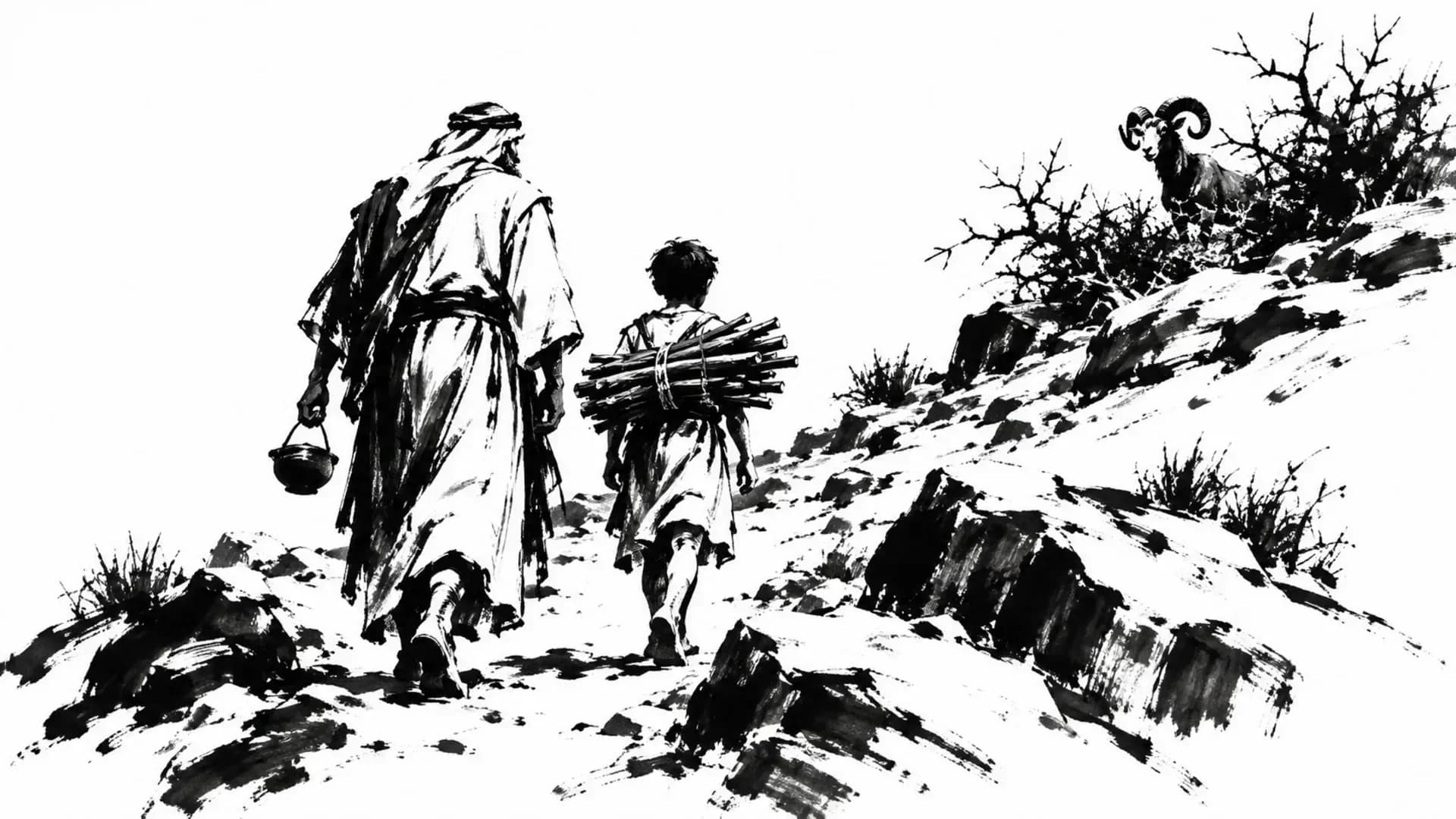
Jehovah Jireh means "the LORD will provide." It is the name Abraham gave to the mountain where God stopped him from sacrificing his son Isaac and supplied a ram in Isaac's place (Genesis 22:14). The Hebrew verb behind "provide" means "to see," so the name also carries the sense "the LORD will see to it."
Many Christians first meet this name in a worship song or on a card taped to the fridge. They say it when the rent is due and the account is short. That is a good instinct. But the name was not coined in a budget meeting. Abraham spoke it on a mountaintop, standing next to an altar he had built for his own son, after the hardest walk of his life.
If you want to know what Jehovah Jireh means for your bills and your fears, start where Abraham started. This article looks at the Hebrew, the scene on Moriah, the other places the same verb appears, and why the name points straight to Jesus.
Jehovah Jireh Meaning in Hebrew
In Hebrew the name is (Yahweh Yireh) יְהוָה יִרְאֶה — "the LORD will see." Strong's Concordance lists the compound name as H3070 and defines it as "Jehovah will see (to it)," a symbolic name for Mount Moriah.
The name has two parts.
The first part is (YHWH) יְהוָה — "the LORD," Strong's H3068. This is God's personal covenant name. Most English Bibles, the NKJV included, print it as "LORD" in small capital letters.
The second part is (yireh) יִרְאֶה — "he will see." It is a form of the verb (ra'ah) רָאָה — "to see," Strong's H7200. Ra'ah is one of the most common verbs in the Old Testament. Bible Hub's concordance counts more than 1,300 occurrences. It means to see with the eyes, to look, to perceive, and to look into something. In a small number of places, translators render it "provide," and Genesis 22 is the most famous of them.
So a word-for-word rendering of Jehovah Jireh is "the LORD will see." The NKJV writes it as one hyphenated name:
Two details in this verse matter for everything that follows.
First, Jehovah Jireh is the name of a place. Abraham did not hold a naming ceremony for God. He named the mountain after what God did there. The name describes God's character, but it is attached to a location and an event.
Second, the last phrase of the verse uses the same verb again in a different form. "It shall be provided" translates (yera'eh) יֵרָאֶה — "it shall be seen." The King James Version keeps the literal sense: "In the mount of the LORD it shall be seen." The proverb Abraham's descendants repeated "to this day" was that on this mountain, something would be seen.
Where the Name "Jehovah" Comes From
The form "Jehovah" is not in the Hebrew text. It is a later English way of writing God's name.
Ancient Hebrew was written with consonants only. God's name was written with four letters, YHWH. Over time, Jewish readers stopped saying the name aloud out of reverence and read the word (Adonai) אֲדֹנָי — "Lord" in its place. When scribes later added vowel marks to the text, they placed the vowels of Adonai under the letters YHWH as a reminder to say "Adonai."
Christian readers in Europe combined those borrowed vowels with the consonants and produced "Jehovah." Scholars usually trace the written form to the early sixteenth century. William Tyndale used a form of it in his 1530 Pentateuch, and the King James Version of 1611 printed "Jehovahjireh" in Genesis 22:14. That is how the name reached English-speaking churches.
Most scholars today think the original pronunciation was closer to "Yahweh." So you will see the name written as Jehovah Jireh, Yahweh Yireh, or Jehovah-jireh. All of them point to the same verse and the same God. The spelling is a matter of history. The meaning does not change.
Jehovah Jireh in the Bible: The Story of Genesis 22
The name only makes sense inside its story. Genesis 22 opens with a command that is hard to read.
Isaac was the son God had promised for twenty-five years. Abraham was a hundred when Isaac was born. Every promise God had made about Abraham's descendants ran through this one boy.
The phrase "whom you love" is the first time the Bible uses the word love. The verb is (ahav) אָהַב — "to love." Its first appearance in Scripture is a father's love for his only son, set on the road to a sacrifice. That detail will matter later.
Abraham got up early the next morning, split the wood, and set out. The trip took three days.
The verb "saw" in that verse is ra'ah again. The chapter keeps returning to seeing. Abraham saw the place. Then he told his servants something remarkable:
"We will come back." Abraham planned to return with Isaac. The writer of Hebrews explains what Abraham was thinking:
Abraham did not know how God would keep the promise. He only knew God would.
Then came the climb. Abraham loaded the wood onto Isaac and carried the fire and the knife himself. On the way up, Isaac asked the question every reader is asking.
"God will provide" is (Elohim yireh lo) אֱלֹהִים יִרְאֶה־לּוֹ — "God will see for Himself." Abraham used the same verb he would later put into the name of the mountain. Before he saw any ram, he told his son that God would see to the lamb.
At the top, Abraham built the altar, bound Isaac, and raised the knife. The Angel of the LORD called his name twice and stopped him.
"Lifted his eyes and looked" is ra'ah one more time. Abraham looked, and the answer was already behind him. The text does not say when the ram arrived. It only says that when Abraham turned around, it was there, caught by its horns, unable to run.
The ram died "instead of his son." That word is the heart of the chapter. Isaac walked down the mountain alive because something else went up on the altar in his place.
Then Abraham named the mountain. He did not call it "Abraham Obeyed" or "The Place of the Test." He named it after what God did: The-LORD-Will-See-to-It.
Why "See" Becomes "Provide"
How does a verb that means "to see" end up translated "provide"?
English already does the same thing. If a friend says, "I need someone to pick up my kids on Thursday," and you answer, "I'll see to it," you have not promised to look at anything. You have promised to take care of it. Seeing to a need means noticing it and then arranging the answer.
Hebrew uses ra'ah this way in Genesis 22. When Abraham said "God will see for Himself the lamb," he meant God would look ahead, spot what was needed, and supply it.
Our English word "provide" has the same idea built into it. It comes from the Latin providere, made of pro ("before, ahead") and videre ("to see"). To provide is, by its roots, to see ahead. "Providence" comes from the same Latin word. So the English translators were not stretching the Hebrew. Both languages connect seeing ahead with supplying the need.
This changes how we read the promise. "The LORD will provide" can sound like God waiting in heaven until we ask loudly enough. "The LORD will see to it" says God saw the need before Abraham reached the mountain. The answer was already in the thicket while Abraham was still climbing.
Jesus taught the same thing about your Father:
Your need is not news to God. He saw it first.
Other Passages That Use the Same Verb
Ra'ah carries the "see to it" sense in a few other places. These help confirm what Genesis 22 means.
Hagar and the God who sees (Genesis 16:13)
Before Moriah, a runaway servant named Hagar met the Angel of the LORD by a spring in the desert. She was pregnant, alone, and had fled from Sarah. God found her and spoke to her. Hagar responded with a name of her own:
"The God who sees" is (El Roi) אֵל רֳאִי — "God of seeing," built from the same root ra'ah. Hagar named God for seeing her. Abraham named the mountain for God seeing to the need. Both names come from the same verb, and both come from people at the end of their own resources.
God provides a king (1 Samuel 16:1)
When Saul failed as king, God sent Samuel to Bethlehem:
"I have provided" is (ra'iti) רָאִיתִי — "I have seen." God had already looked among Jesse's sons and picked David before Samuel filled his horn with oil. Samuel was still grieving the old king. God had already seen to the new one. And it was David's line that would produce Jesus.
The mountain where the LORD appeared (2 Chronicles 3:1)
Centuries after Abraham, the name Moriah appears once more in the Bible:
"Had appeared" is (nir'ah) נִרְאָה — "was seen," again from ra'ah. Abraham's descendants said, "In the Mount of the LORD it shall be seen." Later the LORD appeared to David on Mount Moriah, and Solomon built the temple there. For most of the next thousand years, lambs were offered on the mountain where Abraham had said, "God will see for Himself the lamb."
How Jehovah Jireh Points to Jesus
Genesis 22 is a story about a father, an only son, wood, a mountain, and a substitute. Every one of those pieces shows up again in the Gospels.
The only son whom the father loves
God called Isaac "your only son Isaac, whom you love." John uses the same picture:
The first time the Bible says "love," it describes a father and his only son. The best-known verse in the New Testament describes the Father giving His only Son.
The son carries the wood
Genesis records that Abraham "took the wood of the burnt offering and laid it on Isaac his son" (Genesis 22:6). John records the same detail about Jesus:
The lamb God provides
Isaac asked, "Where is the lamb?" Abraham answered that God would see to it. On Moriah, God provided a ram for Isaac. But the lamb Abraham spoke of had not yet appeared. About two thousand years later, John the Baptist pointed to Jesus and gave the answer:
Jesus Himself said Abraham looked ahead to Him:
Jesus used the language of seeing. Abraham saw Christ's day. Moriah was one of the places he saw it.
The Father who did not hold back
Here the two stories part ways, and the difference is the gospel. God stopped Abraham's hand. Isaac went home alive. Nobody stopped the Father's hand at the cross. Paul draws the conclusion:
Abraham was told, "You have not withheld your son." Paul says the Father "did not spare His own Son." God spared Abraham the thing He did not spare Himself.
A provision prepared ahead
Peter says the Lamb was not a late plan:
That is Jehovah Jireh at its fullest. God saw humanity's greatest need, a lamb to take away sin, before the world existed. He saw to it before anyone asked.
There is a geographic link too. Moriah became the temple mount in Jerusalem, and Jesus was crucified just outside the walls of that same city. The exact spot of Golgotha is debated, but the city is not. The proverb "In the Mount of the LORD it shall be seen" found its answer a short walk from the mountain where Abraham said it.
Jehovah Jireh and the Other Compound Names of God
Jehovah Jireh is often taught alongside a list of other "compound names" of God. Each pairs YHWH with a word describing what God did. A few are worth placing next to Jireh, because they work the same way.
Jehovah Rapha
In Exodus 15:26 God said, "I am the LORD who heals you." The Hebrew is (Yahweh rophe'kha) יְהוָה רֹפְאֶךָ — "the LORD your healer," from (rapha) רָפָא — "to heal." This one is a statement God made about Himself, not the name of a place.
Jehovah Nissi
After Israel defeated Amalek, Moses built an altar and called it "The-LORD-Is-My-Banner" (Exodus 17:15). The Hebrew is (Yahweh nissi) יְהוָה נִסִּי — "the LORD my banner." Like Jireh, it names a place of worship after what God did there.
Jehovah Shalom
Gideon built an altar and called it "The-LORD-Is-Peace" (Judges 6:24), (Yahweh shalom) יְהוָה שָׁלוֹם — "the LORD is peace." If you want to go deeper on that word, read what shalom means in Hebrew.
Jireh is the first of these in the Bible. Before God revealed Himself as healer, banner, or peace, He showed Abraham that He sees ahead and supplies the sacrifice. The others rest on this one. Healing, victory, and peace all come to us through the Lamb God provided.
What Jehovah Jireh Is Not
Because the name is so loved, it gets misused. A few corrections help.
It is not a formula. Saying "Jehovah Jireh" three times over a bill does not unlock money. Abraham did not use the name to get anything. He used it to describe what God had already done. The name is a confession about God's character, not a password.
It is not a reward for a big enough sacrifice. Some teaching turns Genesis 22 into a transaction: give God your Isaac, and He will pay you back. But Abraham did not bring the sacrifice that mattered. God did. The ram was God's. The Lamb was God's. Grace means God sees to the sacrifice Himself, and we receive what He supplied. God does bless obedience, and Genesis 22:16-18 records that blessing. But the name Abraham gave the mountain points at God's supply, not at Abraham's performance.
It is not a promise that you will never climb a hard hill. Abraham walked three days with a knife and his son. Jehovah Jireh did not cancel the walk. It met him at the top.
It does not depend on how the economy is doing. Isaac later lived through a famine and sowed in that land, and God blessed him (Genesis 26). Provision was never tied to market conditions. If this is your fear right now, read why the economy does not set your supply.
What Jehovah Jireh Changes for You
So what do you do with this name on an ordinary Tuesday, when the car breaks down or the diagnosis comes back or the contract falls through?
You can stop rehearsing the need to God as if He has not seen it. Prayer is still right. Paul tells us to make our requests known (Philippians 4:6). But you pray to a Father who saw the need before you did. You are not filing a report with someone who missed it. You are talking to the One who already saw to it.
You can look up and look around. Abraham "lifted his eyes and looked," and the ram was behind him. Some of God's provision is already in your life and you have not turned around to see it. It may be a friend's offer you waved away, or a skill you stopped using years ago.
You can measure every smaller need against the cross. If God already saw to your largest need, sin and death, then rent and groceries are smaller things. That is Paul's argument in Romans 8:32. He gave the Son. He will not hold back the rest. God is supplying, not demanding.
You can rest while you walk. Abraham and Isaac "went together" up the mountain. Abraham did not have the answer in his hand. He had God's word that the answer existed. That is enough to keep walking.
Paul gave the New Testament version of the promise to a church that had sent him gifts while he was in prison:
The supply is "by Christ Jesus." Every provision God gives you comes through the Lamb He provided on the mountain.
Abraham went up Moriah with a question from his son he could not fully answer. He came down with a name for the mountain. Isaac walked beside him, alive, because the LORD saw to it.
God saw your need before you did, and on a hill outside Jerusalem He already saw to it.
Enjoyed this? Get a short devotional like this in your inbox every morning.