
What Does El Shaddai Mean? The Name God Waited 13 Years to Say
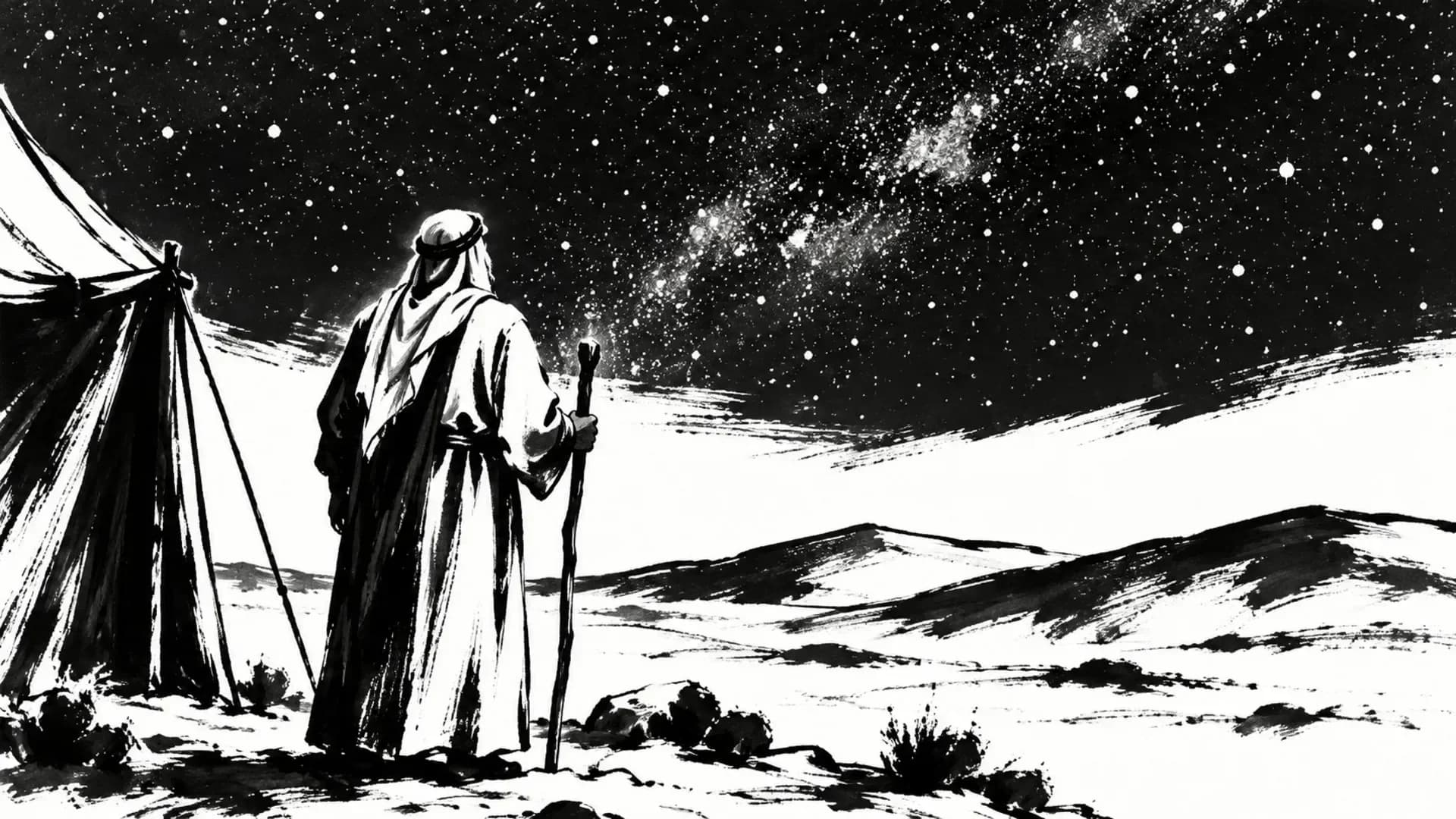
El Shaddai is a Hebrew name of God that English Bibles translate "God Almighty." It presents God as the One whose power is more than enough for everything He has promised. God first used the name in Genesis 17:1, when He spoke to a ninety-nine-year-old man who had no way left to keep the promise he had been given.
Many people look up this name when they have run out of something. The savings are gone, or the diagnosis came back, or a ten-year plan has collapsed. They want to know if the name means anything for a person in their position.
It does. And the timing of the name tells you as much as the dictionary.
El Shaddai Meaning in Hebrew
The name is made of two Hebrew words: (El Shaddai) אֵל שַׁדַּי — "God Almighty." It is pronounced "el shad-DIE."
The first word is (El) אֵל — "God, mighty one" (Strong's H410). It is the shortest and oldest Semitic word for God. On its own it says that God is strong.
The second word is (Shaddai) שַׁדַּי — "the Almighty" (Strong's H7706). This is the word that carries the weight of the name. It appears 48 times in the Hebrew Bible. Seven of those times it stands together with El as the full name El Shaddai: Genesis 17:1, 28:3, 35:11, 43:14, 48:3, Exodus 6:3 and Ezekiel 10:5. The other 41 times it stands alone as "the Almighty."
The book of Job uses Shaddai 31 times, more than the rest of the Old Testament combined. The NKJV renders the full name "Almighty God" or "God Almighty," and the single word "the Almighty."
So the plain answer to "what does El Shaddai mean?" is God Almighty: the strong God who has no rival and no shortage. The rest of this article shows why the Bible attaches that name to specific people at specific moments.
Where Does the Word Shaddai Come From?
Scholars do not agree on the root of Shaddai. You will find confident claims online in every direction, so here are the main options side by side.
Option 1: "Mountain"
Most modern scholars connect Shaddai to the Akkadian word shadû, which means "mountain." On this reading, El Shaddai means something like "God of the mountain," the God who stands firm and high above everything else. It has a weakness: the doubled "d" in Shaddai does not fit the Akkadian form neatly.
Option 2: "Breast"
Another option is the Hebrew word (shad) שַׁד — "breast" (Strong's H7699), which looks very similar. Many devotional writers explain El Shaddai as "the many-breasted One," the God who nourishes and sustains His children the way a mother feeds a baby.
The Bible does place the two words side by side in one verse. When Jacob blessed Joseph, he said:
"The Almighty" is Shaddai. "The breasts" is (shadayim) שָׁדַיִם. The sound match is deliberate. But most scholars treat it as wordplay that Jacob enjoyed, not as proof of where the word came from. It is safe to say the Bible connects the Almighty with nourishment. It is not safe to say Shaddai literally means "breast."
Option 3: "Sufficient"
Ancient Jewish interpreters read Shaddai as two pieces: (she) שֶׁ — "who," and (dai) דַּי — "enough, sufficiency" (Strong's H1767). That gives "the One who is sufficient." The Talmud (Chagigah 12a) turns it into "the One who said 'Enough' to His world," meaning He set the limits of creation.
The Septuagint, the Greek translation of the Old Testament, read it this way in places. In Ruth 1:20 and 1:21 it renders Shaddai as (ho hikanos) ὁ ἱκανός — "the Sufficient One." Most modern linguists doubt this is the historical root, but Jews reading their own Scriptures before Jesus was born did hear "sufficient" in this name.
Option 4: "Destroy"
Strong's concordance links Shaddai to the verb (shadad) שָׁדַד — "to destroy, to devastate" (Strong's H7703). The prophets play on this sound:
In Hebrew, "destruction from the Almighty" is (shod mi-Shaddai) שֹׁד מִשַּׁדַּי, a pun. Most scholars again see a play on words here rather than the origin of the name.
What we can say with confidence
Nobody can settle the root of Shaddai today, so be careful with any teacher who builds a doctrine on one option. What we can settle is how the Bible uses the name, and the moments where God says "El Shaddai" are consistent.
El Shaddai in the Bible: The First Time God Said It
The first time this name appears, God says it about Himself:
To see why this matters, you have to read the chapter before it.
God had promised Abram a son. Years passed and nothing happened. So Sarai gave Abram her maid Hagar, hoping to obtain children through her (Genesis 16:2). Hagar conceived. Ishmael was born. And Genesis records Abram's age at that moment:
The next verse in the Bible is Genesis 17:1, and Abram is ninety-nine. Between the two verses, thirteen years pass without one recorded word from God.
Abram had believed God was mighty. But when the promise stalled, he and Sarai treated God as someone who needed help. Ishmael was human strength trying to deliver a divine promise.
So God waited. He waited until Abram's body could no longer produce the promise by any means. Paul describes the condition exactly:
Then God spoke the name. In effect He said, "You have known Me as mighty. Now know Me as Almighty." The name arrived on the day Abram's own options ran out.
That is the first and clearest El Shaddai meaning in the Bible: God Almighty is the God who keeps His promise after your ability to keep it is gone.
Abraham's response was not perfect. He laughed:
God did not withdraw the promise because of the laugh. He named the boy Isaac, which means "he laughs." A year later the promise arrived on schedule:
If you belong to Christ, this is your family story too. Paul says believers are Abraham's seed and heirs of the same promise. The God who met Abraham at ninety-nine is the God who meets you.
"Walk Before Me and Be Blameless"
Many readers stumble over the second half of Genesis 17:1. They read "be blameless" and hear a demand: become perfect, and then God will act.
The order of the sentence says otherwise. God first says who He is: "I am Almighty God." Only then does He say "walk before Me." Blamelessness comes last.
"Before Me" translates (lefanai) לְפָנַי, built on (panim) פָּנִים — "face." God was inviting Abraham to live in front of His face, aware that God was looking at him with favor. This was not a summons to a courtroom. Abraham had spent thirteen years acting as if he had to manage the promise himself. Now God asked him to live in God's sight instead.
"Blameless" translates (tamim) תָּמִים — "whole, complete, without blemish." It is the same word used for an unblemished sacrificial lamb. God did not say, "Be blameless, and then you may walk before Me." He said, "Walk before Me, and be blameless." The wholeness grows out of the walk.
The rest of the chapter confirms that God carries the weight. God says "I will" again and again: I will make My covenant, I will multiply you, I will give you the land, I will bless Sarah. Abraham's part was to receive, and to wear the new name God gave him:
"I have made you." God spoke of the father of many nations as already done while Abraham still had only Ishmael.
This is grace in Genesis, 400 years before the Law of Moses. The Almighty does not ask you to become whole so that He can show up. He shows up, tells you who He is, and wholeness follows the people who live in front of His face.
How El Shaddai Was Passed From Father to Son
After Genesis 17, the name El Shaddai becomes the family's name for God. Each time it appears, someone is facing a need they cannot meet.
Genesis 28:3: Isaac blesses Jacob as he flees
Jacob was leaving home with nothing, running from a brother who wanted to kill him. His father blessed him with the family name for God:
Jacob left with a staff and no wife. He came back as "two companies" of family and flocks (Genesis 32:10).
Genesis 35:11: God repeats the name to Jacob
Years later God confirmed it in His own voice:
These are nearly the same words God spoke to Abraham. The promise did not shrink when it passed to a son with a worse record.
Genesis 43:14: Jacob's prayer for Benjamin
During a famine, Jacob had to send his youngest son Benjamin to Egypt. He had already lost Joseph. This was the moment he feared most, and he reached for the name his father had prayed over him:
Jacob did not know that "the man" in Egypt was Joseph. El Shaddai had already placed the answer in the palace before Jacob prayed.
The pattern across these passages is simple. El Shaddai is spoken over childlessness, exile, famine and fear. It is the name for situations where human supply has failed.
Naomi, Job and Psalm 91: The Almighty in Hard Places
Outside Genesis, the shorter name "Shaddai" shows up in some of the darkest chapters of the Old Testament.
Naomi blames the Almighty
Naomi lost her husband and both sons in Moab. When she came home, she refused her own name:
Naomi used the name Shaddai twice, and both times she used it as an accusation. She believed the all-powerful God had turned His power against her.
The book of Ruth does not argue with her. It simply tells what the Almighty did next. Ruth stayed with her. Boaz showed up in the barley field. A grandson was born. And the women of Bethlehem told Naomi:
Naomi said, "I went out full and came home empty." The story ends with a nourisher in her arms (Ruth 4:16). The Almighty she blamed was the One who filled her again. If you are angry at God right now, you are not the first person to say His name with bitterness, and the story is not over.
The kindness Ruth and Boaz showed Naomi is the Hebrew word hesed, God's covenant love. It was the means the Almighty used to restore her.
Job and the Almighty
Job and his friends argue about Shaddai for chapter after chapter. The friends assume the Almighty is punishing Job. Job assumes the Almighty has become his enemy. Both are wrong. At the end, the Lord gave Job twice as much as he had before (Job 42:10).
Psalm 91: living in His shadow
The most quoted use of Shaddai is in Psalm 91:
"The Most High" is (Elyon) עֶלְיוֹן and "the Almighty" is Shaddai. Both names were first revealed in Abraham's life: El Elyon in Genesis 14, El Shaddai in Genesis 17. The psalm takes the God of Abraham and turns His names into a place to live. You do not visit the shadow of the Almighty. You abide there.
El Shaddai vs. Yahweh
The most important contrast for this name comes in Exodus, when God spoke to Moses:
"God Almighty" is El Shaddai. "Lord" is (Yahweh) יְהוָה — "the LORD." It is God's personal covenant name, often explained from the Hebrew verb "to be" as "I AM" (Exodus 3:14).
This verse does not mean the patriarchs had never heard the name Yahweh. Genesis uses it in their stories, including Genesis 17:1. It means they mainly experienced God as El Shaddai: the powerful God who protected them and provided for them in a foreign land. Israel was about to experience God as Yahweh, the God who redeems a whole nation and lives among them.
The two names do not compete. El Shaddai tells you what God is able to do. Yahweh tells you who He is to you personally and that He has bound Himself to you by covenant. A God who is only Almighty can still feel distant. A God who is Almighty and also your covenant Lord is power you can trust.
El Shaddai in the New Testament
The New Testament is written in Greek, so the name El Shaddai does not appear in Hebrew form. But the idea carries straight through in two Greek words.
Pantokrator: "the Almighty"
The Septuagint often translated Shaddai as (pantokratōr) παντοκράτωρ — "ruler of all, the Almighty" (Strong's G3841). That word appears ten times in the New Testament: nine times in Revelation and once in 2 Corinthians. Revelation uses it in the Lord's own announcement:
The one use outside Revelation tells you how the Almighty wants to relate to you:
This is the New Covenant change in the name. Abraham knew the Almighty as the One who appeared to him. You know the Almighty as Father, through a family relationship that Jesus purchased.
Hikanos: "the Sufficient One"
The Septuagint also translated Shaddai as (hikanos) ἱκανός — "sufficient, enough" in Ruth 1:20-21. Paul uses this same word family when he describes where his ability comes from:
"Sufficient" is (hikanoi) ἱκανοί and "sufficiency" is (hikanotēs) ἱκανότης. Paul is not quoting Ruth, and we should not claim he had El Shaddai in mind. But it is the same idea the old translators heard in the name: your adequacy comes from God.
Later in the same letter the Lord tells Paul:
The verb here is a different Greek word, (arkei) ἀρκεῖ — "is enough." But the truth is the one God showed Abraham at ninety-nine: God's strength shows up where your strength has ended. Grace is the New Testament form of that sufficiency, and the Greek word for grace, charis, carries the same idea of a gift you cannot earn.
What El Shaddai Does Not Mean
Because the name is popular, it gets stretched.
El Shaddai is not a password. Saying the name does not force God to act. Abraham did not call on El Shaddai to get results. God introduced Himself.
El Shaddai does not mean God helps those who help themselves. The first appearance of the name comes right after Abraham's self-help plan produced Ishmael. God waited until that route was closed. The name is good news for people who cannot help themselves.
El Shaddai does not mean a God of power without affection. "Almighty" can sound cold. But the same Almighty gave a son to a childless couple and filled an empty widow's arms. And in 2 Corinthians 6:18 the Lord Almighty calls Himself Father.
El Shaddai does not prove one theory of the word's root. Be cautious with any article that says the name "literally means" breast or mountain as if the matter were closed. The biblical usage is clear, and it is enough.
What the Name Means When You Have Run Out
Abraham did not get the name El Shaddai when he was strong. He got it when his body was "already dead." So the name means something specific for the person reading this with an empty account or a body that has stopped cooperating.
Stop producing Ishmaels. If you have spent years trying to make a promise happen in your own strength, you can stop. Genesis does not describe the thirteen silent years as punishment. God waited until Abraham could see that the promise would be God's work.
Live before His face. Start the day aware that God looks at you with favor, because of Jesus. Do not wait until you feel blameless. Walk in front of Him first, and let the wholeness follow.
Pray the family name. Isaac and Jacob both prayed "God Almighty" over their sons. You can pray the same name over your children and your needs, because you are in the same family.
Take your bitterness to Him, too. Naomi blamed the Almighty out loud, and He restored her anyway. You do not have to clean up your words before you come.
At ninety-nine, Abraham had nothing left to offer God. That is exactly where God told him His name.
El Shaddai does not wait for you to be strong. He waits until you stop pretending you are, and then He tells you His name.
Enjoyed this? Get a short devotional like this in your inbox every morning.